


Skip to search form

Related subjects:

Abercrombie Plan 1944

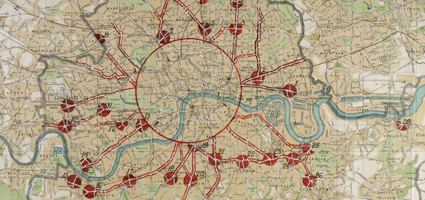
Professor Patrick Abercrombie (1879–1957) was a trained architect and town planner. He prepared the ‘County of London Plan’ (1943) and The Greater London Plan (1944) during the Second World War as a blueprint for London’s post-war reconstruction and development.

Land used for allotments during the war and bomb-damaged areas presented a post-war opportunity for a network of open spaces that Abercrombie hoped would contribute to the improvement of people’s health and wellbeing.

He established ‘Standards of Open Space’ which recommended that, for every thousand city inhabitants, there should be at least four acres of open space available. This figure was much less than proposals suggested by councils before the war, but the calculation took account of high levels of development already encroaching on certain areas.

Abercrombie proposed a network of ‘parkways’ to run along existing roads and footpaths to provide connections ‘from garden to park, from park to parkway, from parkway to green wedge and from green wedge to Green Belt’. He also believed that the Green Belt should be kept free from building development. Instead, he proposed that it be divided into two rings: the ‘Green Belt Ring’ (about five miles wide) and the ‘Outer Country Ring’. The ‘Green Belt Ring’ was to be used for Londoners’ recreational activities and the Outer Ring was to be reserved for agriculture. Abercrombie himself described the concept of preserving the land as ‘revolutionary’.

Part of the ‘County of London Plan’ also included proposals for the construction of a series of satellite towns or ‘New Towns’ in or around the city’s Outer Country Ring. This was to address the housing needs of a growing urban population by attracting industry out of the centre of London. As the British economy was still in recovery after the war, progress on the New Towns was much slower than predicted. It was not until 1951 that towns like Stevenage and Harlow came into their own, attracting thousands of Londoners who found work in the local factories and service industries.

During the 1960s, the New Towns initiative was criticised by those who argued that only the most mobile Londoners could afford to leave the City, and that the plan had failed to address the real housing shortage in the poorest areas. Overall, the plan proved to be a success, and was used as an example of progressive town planning across the globe.

The Museum of London is funded by the Department of Culture, Media and Sport and the Corporation of London London Wall, LONDON EC2Y 5HN, United Kingdom. Copyright Museum of London, 2005 All rights reserved. This site is maintained by the Museum Systems Team.