

Skip to search form

Related subjects:

Carnaby Street

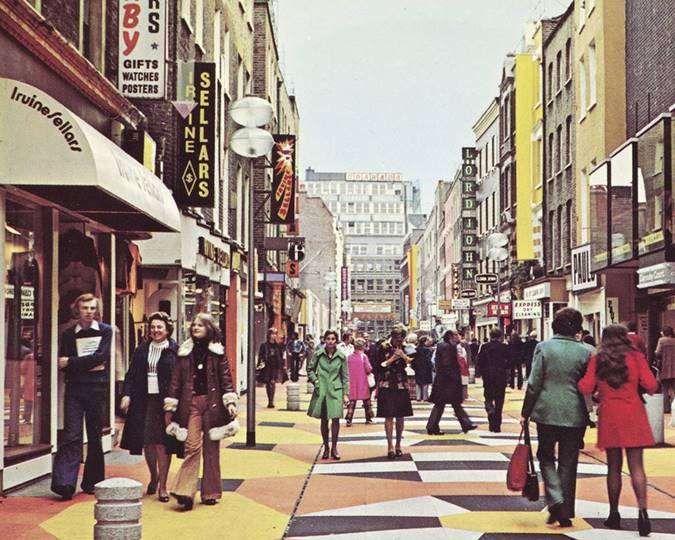
During the 1960s, Carnaby Street in Soho became world famous as a hot spot of ‘swinging London’. It was a key place for Britain’s youth revolution and had a long-term influence on London’s shops, fashions and tourist industry. By the end of the 1960s, Carnaby Street was London’s second-most-visited tourist attraction after Buckingham Palace.

Before the 1960s, Carnaby Street was a place of run-down, cheaply rented property. It was on the western, quieter, edge of Soho and housed workshops, a few local shops and restaurants. Its transformation into a world-famous shopping street began with John Stephen, a clothing entrepreneur who had arrived in London from Glasgow in 1952, aged 19.

Stephen began his career working for Moss Bros, but started his own menswear workshop on Beak Street in the mid-1950s. A fire caused him to move around the corner to Carnaby Street, where he also opened a shop to sell directly to the public.

His designs were considerably more flamboyant than traditional menswear, and popular demand encouraged him to open other small shops in the streets with names such as ‘His Clothes’ and ‘Male West One’. Other clothing manufacturers followed suit and by the early 1960s the street was being taken over by small ‘boutiques’, selling cheap and fashionable clothes directly to a young clientele.

Carnaby Street boutiques had distinctive names: Lord John, Take Six, I was Lord Kitchener’s Valet and Gear, which opened in 1964 and had an interior filed with Victorian bric-a-brac. The street widened its appeal when womenswear was introduced. Lady Jane, the female equivalent of Lord John, opened in 1966. Other types of shops arrived including the shoe shop Ravel, the outlet for an old firm of London shoemakers, and the first branch of health-food shop Cranks. The street also housed the Roaring Twenties Night Club, run by the West Indian club owner Count Suckle.

The secret of Carnaby Street’s success lay in what was sold and how it was sold. For menswear in particular, Carnaby Street clothes were distinctive: ‘ the codswallop fashions of perverted peacocks’, said one newspaper.

Designers competed with each other to come up with original and outrageous ideas. Incorporating the Union Jack into as many items as possible was a Carnaby Street favourite. Another was the colour combination of purple and orange. These were clothes for a new generation, and were just as deliberately provocative as the newly fashionable long hair on men and short skirts on women.

The idea of selling clothes to the young through small distinctive ‘boutiques’ was also a Carnaby Street innovation. Although Mary Quant had started the trend with Bazaar in Chelsea, her boutique was aimed at a more design-led clientele. Carnaby Street shops were more like factory outlets or market stalls, selling direct to a mass market of teenagers. The shops’ success led mainstream retailers to open their own youth boutiques. ‘Way In’ in Harrods and ‘Miss Selfridge’ in Selfridges were both attempts to capture the Carnaby Street spirit within department stores.

The Museum of London is funded by the Department of Culture, Media and Sport and the Corporation of London London Wall, LONDON EC2Y 5HN, United Kingdom. Copyright Museum of London, 2005 All rights reserved. This site is maintained by the Museum Systems Team.