Trade links between Britain and India commenced in 1600 with East India Company ships bringing goods, as well as Indian sailors, back to London.
Britain gained increasing amounts of territory in India, so that by the end of the 19th century the British government ruled the sub-continent.
Meanwhile, London was home to Indian lascars, nannies, merchants and students, and two Indian MPs were elected to London constituencies.
Future national leaders studied in London from the 19th century, receiving an education which equipped them to achieve independence for India.
Labour shortages in Britain coupled with the partition of India in 1947 caused Indians to come to London seeking jobs.
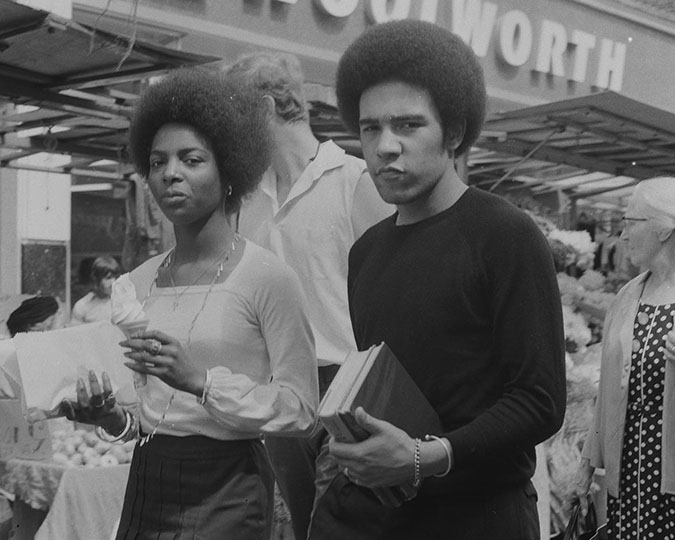
The 1960s and 1970s saw many Indian women and children join their husbands in Britain. Asians expelled from Africa, who were mainly Gujarati, also sought refuge in Britain at this time.
The founding of the East India Company and its exploits in India, first through trade and later through conquest and colonisation, leading to the British Raj, set in motion forces that would profoundly affect both India and Britain, altering their historical relationship and development.Rozina Visram 'Asians in Britain: 400 Years of History', 2002
|
Contact between Britain and India began in 1600 when Elizabeth I granted the East India Company permission to buy and ship goods like spices and silks from India.
Some British seamen fell ill or died during the long voyages. Thus Indian seamen, called lascars, were employed to replace them and arrived in London from the 1620s.
During the 18th century, the East India Company consolidated its hold on India as the Muslim Mughal rulers began to lose their grip on the country.
The Company fought wars against the French, as well as local rulers, and gained territory in Bengal, Bihar, Madras and Bombay. Meanwhile a small South Asian community of sailors, servants and nannies grew up in London.
By the 19th century, the East India Company ruled India, until the British government took over this role in 1858. Queen Victoria became Empress of India in 1877 and there was considerable traffic back and forth between the two countries.
Lascars were employed on board British ships on short term contracts. These sailors were often left in port destitute until their next ship sailed back to India.
Their plight caused public concern, and in 1857, the Strangers' Home for Asiatics, Africans and South Sea Islanders opened in Limehouse to provide temporary accommodation for stranded sailors.
Indian nannies, called ayahs, and domestic servants, often found themselves in a similar situation when brought to London by British families returning from India. Those who were discharged and left penniless on arrival found shelter at the Ayahs' Home in Hackney.
A diverse community of South Asians lived in 20th century London. In addition to the sailor population, there were merchants, doctors, lawyers and students.
Wealthier Indians sent their sons to be educated at British public schools and universities. Gandhi, Nehru and Jinnah, the great 20th century political leaders, all studied law in London.
From the 1920s Sikhs from the Punjab settled in the East End and made a living selling goods from door to door. The first Indian restaurants opened in the same period.
Amongst those who became involved in the campaign for Indian independence were Dadabhai Naoroji and Shapurji Saklatvala, both London MPs, and Krishna Menon, who also launched the Pelican Books imprint with Allen Lane.
Chuni Lal Katial became the country's first South Asian mayor in 1938, and was also one of around 200 South Asian doctors in pre-war London.
Indians made a huge contribution during both world wars. Nearly one and a half million Indian soldiers fought in Europe on the Allied side in World War I and two and a half million during World War II.
After the war, Indians were even more determined to gain their country’s independence.
At the same time that India achieved independence in 1947, it was partitioned. The northwest and northeast sections of India became Muslim-dominated Pakistan.
This caused a major upheaval with Muslims in India trying to enter Pakistan as Hindus in Pakistan attempted to reach India. The result was a population of displaced people, pressure on the economy and an emphasis on existing land shortages.
Some Asian men decided to come to Britain to make a new life. The migrants settled in areas where there were labour shortages, as Punjabi Sikhs did in Southall in west London. Many Bengalis found work in the textile trade in Tower Hamlets.
The National Health Service recruited for doctors in India from the early 1960s. Over 27,000 Indian doctors currently work for the NHS.
Some African countries believed that Indian settlers had achieved economic success at the expense of the African inhabitants.
So in 1968 Kenya expelled British passport-holding South Asians, followed by Uganda in 1972. Although entry to Britain was made difficult, many of these African Asians settled in Harrow and Wembley in north west London and established businesses.
Today, large numbers of people of Indian descent have gone into professions like medicine and law. Others are successful businessmen like steel magnate Lakshmi Mittal and the Hinduja brothers.
Figures like Salman Rushdie, Vikram Seth, Meera Syal and Krishnan Guru-Murthy have made their names in the arts and media.
According to the most recent census, the total number of people of Indian descent living in London is just over 437,000.
The Indian population is the largest minority ethnic group in the capital. In addition to other areas of settlement, many Indians have made their home in Neasden and Hendon in north west London. Southall and Hounslow to the west also have a large Indian population, the majority of which is Sikh.
Other sizeable Indian communities reside in the Seven Kings and Green Street neighbourhoods in east London. The latter is thronged with shops and stalls selling Asian clothing, jewellery and food.
The main religions practised by Indian people are Hinduism, Islam and Sikhism. London's many temples, mosques and gurdwaras are central to these believers' religious lives.
Bibliography
Links