
Skip Navigation LinksLearning Online/ Features & fact packs/ 1558 to 1837/ Investigate the Great Fire of London
Sitemap | Help
Photograph of a carved wooden sun with radiating rays and a peaceful human face

Half a million years for you to discover

Investigate The Great Fire of London

print

Was the Great Fire 'God's terrible voice in the city', or were there more down-to-earth reasons why the fire of 1666 was so destructive? Find out why the fire spread and how people responded.

A selection of objects that survived the Great Fire, that can now be seen on display in the Museum

enlarge image

A selection of objects that survived the Great Fire, that can now be seen on display in the Museum

Fire risk in the city

Fires in the city of London were fairly common. Most buildings were built from wood, but they were heated and lit with open fires. Many industries relied on coal and wood to provide power. In 1662 a law was passed ordering every household to provide light between sunset and nine in the morning to help passers by. There was no fixed street lighting so these lights were open flames. This further increased the risk of fire.

Fires were considered a local problem and there was no organised fire brigade for the city as a whole. If a fire broke out, buildings around it were pulled down to create a firebreak and stop it spreading. The Aldermen of each of the city wards had to provide buckets, hand squirts (pumps) and hooks for pulling down buildings.

The Great Fire

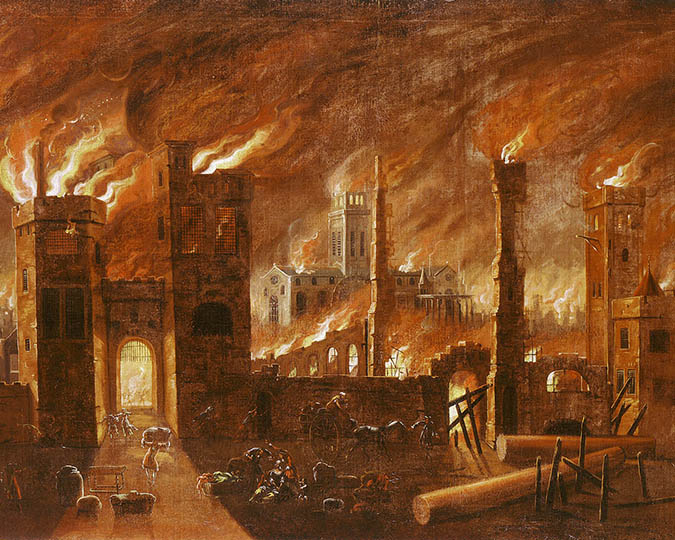
August was a dry month in 1666. When fire broke out in baker Thomas Faryner's kitchen on September 1st of that year, it spread rapidly. The wooden city burned for six days. The fire destroyed about four fifths of the area within the city walls. The damage was valued at more than 800 times the city's total annual income.

Who were the victims?

There is no exact record of how many people died because of the fire. Many died later from exposure to cold weather and the lack of good housing.

Thousands of people lost their homes and were forced onto the street. Some parishes helped by providing food and accommodation. The King provided some army tents and food and permitted temporary houses to be built on open spaces north of the city wall. Churches and public buildings were also used to store property.

Many people went to live in areas outside of the City walls such as Moorfields and Highgate to the north and Soho fields to the west. Charles II gave orders for these parishes to provide cheap lodgings and allow Londoners to trade in the local areas.

Many Londoners came back to the City. Rents were high in the surviving houses. The poor were forced to use their cellars or to set up shelters of reclaimed brick and timber on the ruins of their houses.

Why was the damage so bad?

  • The houses were packed close together with upper floors that overhung the narrow streets. Their hollow walls helped flames to rise and the flammable pitch used to waterproof homes made fire difficult to put out.
    The fire started in an area close to warehouses made of wood which stored pitch, oil, spirits, tallow, resin, hemp, hay and coal that provided fuel for the fire.
  • There was no fire insurance and so many people were reluctant to have their houses pulled down to create firebreaks.
  • The long, hot summer had dried out the wooden buildings, which meant they caught fire easily. Water supplies were short and the wind fanned the fire across firebreaks.

Who was to blame?

Because of strong anti-Catholic feeling many people blamed Catholics for starting the fire. Others thought it was God punishing the sins of the city people. The French, Spanish, Dutch and Irish were also suspected as Britain was at war with these countries. People from those countries staying in London were attacked, their property stolen and their houses pulled down. A young Frenchman, Robert Hubert confessed to starting the fire and was hanged at Tyburn (now Marble Arch). It was later discovered that he had actually arrived in the country two days after the fire had started.

At the inquiry into the fire held at the Old Bailey in October 1666, Thomas Faryner stated that after midnight he had 'gone through every room and found no fire, but in one chimney, where the room was paved with bricks, which fire I diligently raked up in embers ... no window or door might let wind disturb them and that it was absolutely set on fire on purpose...'

In 1667 the fire was officially attributed to 'the hand of God, a great wind and a very dry season...'

The rebuilding of London

A large part of the City of London needed to be rebuilt. By autumn 1666, a Royal proclamation ordered that all new buildings should be built of brick to reduce the risk of fire. But there was little help for poorer people who had to pay for the rebuilding of their own houses in new materials.

Sir Christopher Wren and the famous scientist Robert Hooke headed a commission that introduced the Rebuilding Act of 1667. This included a ban on overhanging bays and said that all shop fronts must be the same. A tax on coal provided some of the funds for new public buildings. Wren also worked on many of the rebuilding projects including St Paul's Cathedral, city churches and the Monument built to commemorate the fire.

Interpretation Unit, Museum of London (ed. Jane Sarre)
August 2002

For more information...

Visit the Museum to see...

The Great Fire audio-visual experience. Fragments of buildings that survived the fire can be seen in the Early Stuart gallery. Remains of the old cathedral, as well as Wren's work on the new, are displayed in the Late Stuart gallery.

Find these books in your local library...

De Beer, E., ed. John Evelyn's Diary (Oxford University Press,1955)

De Mare, E. Wren's London (London Folio Society, 1975)

Galinou, M. & Hayes J. London in Paint: catalogue of oil paintings in the Museum of London (Museum of London, 1996)

Latham, R. The Illustrated Pepys' London (Unwin Paperback, 1982)

Latham, R., ed. The Shorter Pepys (Penguin Books, 1993)

Milne, G. The Great Fire of London (Historical Publications Ltd, 1986)

Porter, Stephen, The Great Fire of London (Bramley Books, 1996)

Weinreib, B. & Hibbert, C. The London Encyclopaedia (Macmillan, 1993)

Pack for teachers...

Worsnop, R. The Great Plague and the Great Fire of London (Wolf Pack W6, ISBN 1854503200)

Visit these websites...

Extracts from Samuel Pepys' diaries

History of fire-fighting in London

top
 
Level A conformance icon, W3C-WAI Web Content Accessibility Guidelines 1.0 Curriculum online logo: link opens new window