Skip Navigation LinksLearning Online/ Features & fact packs/ 410 to 1558/ What was life like in medieval London?
Sitemap | Help
There was an error displaying ads.

Half a million years for you to discover

What was life like in medieval London?

print


Old London Bridge, late 16th century.

enlarge image

Old London Bridge, late 16th century

London changed enormously between 1066 and 1500. But it was still tiny by modern standards. Places like Hackney, Brixton and Wandsworth were villages surrounded by farmland.

What did London look like?
Who lived there?
What was daily life like?
How was London organised?
Hospitals and health
Glossary
For more information...

'Paul's Church', City of London, c1634-c1642

enlarge image

'Paul's Church', City of London, c1634-c1642

What did London look like?

Despite being the largest city in medieval England, you could walk across London in twenty minutes. Most of it lay inside the stone city wall originally built by the Romans. The wall’s large gates were locked and guarded at night. Outside the wall was a moat and beyond that were fields. As the population increased, suburbs developed outside the gates, particularly towards Westminster where Edward the Confessor had built a royal palace. This became the centre of government, law and finance.

Along the Thames, barges transported grain, timber and stone while ships from overseas imported goods such as wine and silk and exported English wool and cloth. Between 1176 and 1209, the first stone bridge was built across the river. Houses and shops were built on it and the town of Southwark developed at the south end of it.

Shops along the sides of the main shopping streets opened at the front to sell goods directly to passers-by. These streets also had market stalls down the middle. Many side streets were named after trades carried out there. Threadneedle Street, for example, was the tailors’ district, Bread Street contained bakeries and fish was sold in Fish Street Hill.

The first stone houses were built in the 12th century, but most houses throughout the medieval period were timber-framed. The walls were made of ‘wattle and daub’ and whitewashed. By the 15th century some were up to five storeys high and hung over the streets.

There were many churches and monasteries. St Paul’s Cathedral, with its towering wooden steeple, was the city’s main landmark.

Geoffrey Chaucer, 1843, possibly based on a medieval portrait.

enlarge image

Geoffrey Chaucer, 1843, possibly based on a medieval portrait

Who lived there?

In 1066 London’s population was about 10,000. By 1300 it expanded to over 80,000, but after famines and the Black Death it fell again to about 40,000. People moved to London from all over England to find work and better lives for their families. The wealthiest people lived in mansions, usually along the Strand close to Westminster.

There was a small but flourishing Jewish community in the city – including many businessmen and their families ¬– until 1290 when they were expelled. From the 14th century, immigrants arrived from overseas, including skilled craftspeople from Flanders Most settled in Southwark. Foreign merchants from cities like Venice, in Lombardy, set up banks and businesses in the street still called Lombard Street.

Three particularly successful Londoners were Geoffrey Chaucer, the first great English poet; William Caxton, who set up the first printing press in 1476 in Westminster; and Dick Whittington, four times mayor, who left £6000 when he died, the equivalent of about £6 million today.

What was daily life like?

Traders, peasants, beggars, thieves, herders and livestock all jostled through the busy city streets. Women worked in many different trades.

People cared about hygiene. Toilet waste usually went into cesspits – the solid residue was taken away by night-soil men to be used as manure. Rubbish was collected by ‘rakyers’ (rakers) and taken to ‘lay-stalls’ outside the city. In the 13th century, city authorities built pipes to bring in fresh water.

Most schools were run by the church. In the 12th century, three grammar schools were attached to London churches, with more schools attached to parish churches. Most children received some education, whether from their parents, in school or with their masters if they were apprentices.

How was London organised?

After the Norman Conquest, French merchants moved to London. They brought the idea that towns should manage themselves independently from the king. Londoners gained some independence and around 1189 they chose their first mayor, although the wealthiest men still controlled the city as aldermen. When the Common Council was set up in the 14th century, most people couldn’t vote for it as all women and most men had no vote. Only ‘freemen’ could vote – usually those who had served an apprenticeship of at least seven years in a recognised business or craft.

London’s guilds controlled apprenticeships and therefore entry to the ‘freedom of the city’. Each trade and craft had a guild – whose rules encouraged and protected their craft – and a special feast day. As they grew in wealth and power, the guilds acquired royal charters and coats of arms.

Seal of St Bartholomew's Hospital, c12th century.

enlarge image

Seal of St Bartholomew's Hospital, c12th century

Hospitals and health

The lack of medical knowledge made many common illnesses and accidents life- threatening. By 1349, the bubonic plague or ‘Black Death’ had reached London and within the year, about one in three Londoners was dead.

Doctors cared for sick rich people at home while monks looked after the poor in hospitals. The largest London hospital was St Mary’s outside Bishopsgate, with 90 beds. Several patients shared each bed. It also had a cemetery for those who died. Other large hospitals were St Bartholomew’s and St Thomas’s, which still exist today.

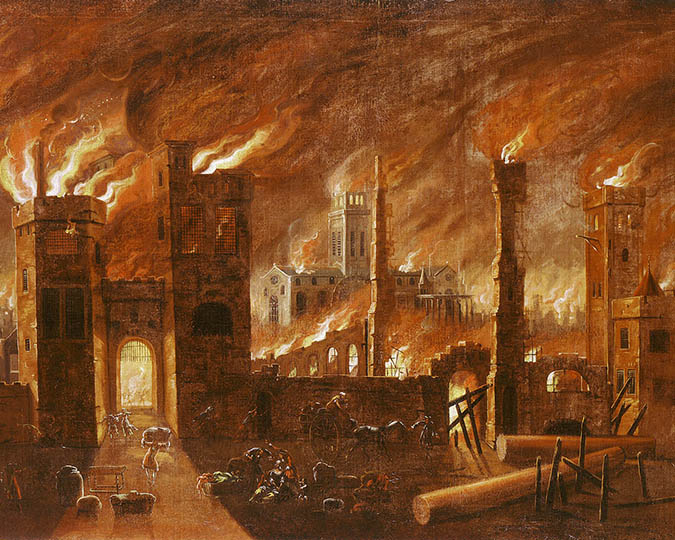
Much of medieval London was lost in the Great Fire of 1666, but some traces still survive – if you know where to look!

Glossary

Guild - Professional society

Flanders - European coastal region including the north of Belgium, part of north-eastern France and the Netherlands

Lay-stalls - Rubbish heaps

Lombardy - Kingdom of north-central Italy

For more information...

In the Museum…

Visit the Medieval gallery

Find these books in your local library…

Mason, James, A Sense of History - Medieval Realms (Longman, 1991)

Place, Robin, History in Evidence – Medieval Britain (Wayland, 1989)

What Life was like in the Age of Chivalry (Time Life Books, 1997)

On the internet…

Events and exhibitions at the Medieval gallery

Medieval English urban history

top
 
Level A conformance icon, W3C-WAI Web Content Accessibility Guidelines 1.0 Curriculum online logo: link opens new window