'Mixing with all sorts: Turkish, English, Jewish. All sorts. I am not old-fashioned,' said Mrs Islam. 'I don't wear burkha. I keep purdah in my mind, which is the most important thing. Plus I have cardigans and anoraks and a scarf for my head. But if you mix with all these people, even if they are good people, you have to give up your culture to accept theirs. That's how it is.''Brick Lane' Monica Ali
|
Commerce between Britain and Asia became a lucrative business from 1600 when the East India Company was granted a royal charter permitting it to trade exclusively with India. Indians were brought to Britain as servants from the 1620s.
By the following century, the small Indian population in London worked as sailors, servants and nannies. Meanwhile, the vogue for exotic objects from China led rich people to employ Chinese servants.
The first records of lascars, sailors from South Asia, at the London docks, date from the 1730s and Chinese sailors are recorded there from the 1780s.
Foreign sailors employed by British shipping companies were much neglected. They were often left in port destitute until the next ship sailed. Their plight caused public concern, and in 1857, the Strangers' Home for Asiatics, Africans and South Sea Islanders opened in Limehouse to provide temporary accommodation.
The Indian sub-continent, Hong Kong and part of Malaysia all became part of the British Empire in the 19th century. People from these lands were now British subjects and could enter Britain freely. Some came to London as visitors and students, while others remained permanently. Many of today's Londoners can trace their ancestry to Asia directly because of its exploitation by Britain at this period.
A small Chinese community existed in Limehouse until World War II, when the area suffered extensive bomb damage. It included sailors, laundry workers and restaurant and shop owners.
A diverse community of South Asians lived in London in the first part of the 20th century. From the 1920s Sikhs from the Punjab settled in the East End and made a living selling goods from door to door. The first Indian restaurants opened at the same time.
In addition to the sailor population around the port, there were nannies, merchants, doctors, lawyers and students. Several became involved in the campaign for Indian independence.
London experienced a labour shortage during the years of postwar reconstruction. The 1948 British Nationality Act gave British citizenship to all people living in Commonwealth countries, and full rights of entry and settlement in Britain. Citizens from these countries were recruited to London by the National Health Service and London Transport.
As well as these motivating factors, the partition of India in 1947 caused major upheaval and created a population of displaced people. Some Asian males decided to come to Britain to make a new life. Many Punjabis settled in Southall to work in expanding new industries, while Bengalis found employment in the textile trade in Tower Hamlets.
The Chinese community began to move into Soho, where the Chinese restaurant business took off. Chinese, mainly from Hong Kong and the New Territories, came to London to staff these establishments. Chinatown grew up around Gerrard Street during the late 1960s.
British passport-holding South Asians were expelled from Kenya in 1968 and from Uganda in 1972. Although entry was made difficult, many settled in London and established businesses.
In 1979 Britain, which then governed Hong Kong, granted asylum to thousands of Vietnamese people escaping refugee camps by sea in the aftermath of the Vietnam war.
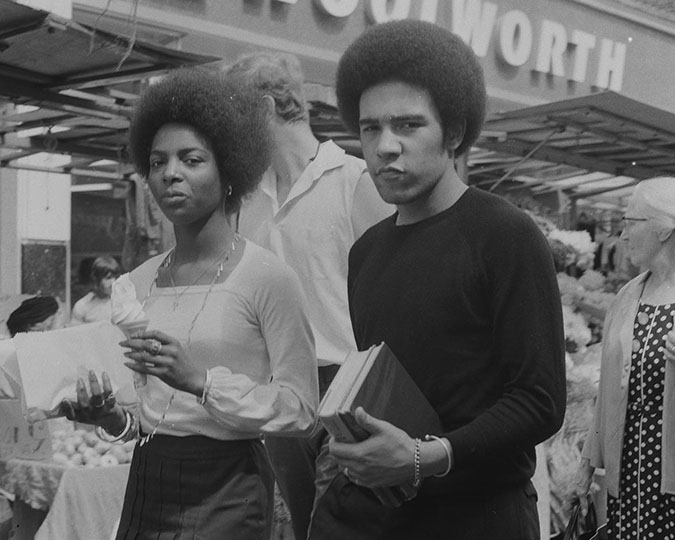
The Asian communities which settled in London in the postwar period have expanded and the original settlers now have children and grandchildren. These younger generations may have spent their whole lives in London and have adapted to speaking English and to a British way of life.
This can lead to tensions between older family members who seek to conserve their language and customs, and younger people who have different experiences and aspirations.
Since the 1990s students and workers from the Chinese mainland have been arriving in London in search of educational and employment opportunities.
Founded in 1996, Asia House in the West End is a leading promoter of pan-Asian culture. It hosts events and offers a meeting place for people to exchange ideas, reflecting the changing status of China and India, which currently have the two most rapidly expanding major economies in the world.
Bibliography
Links