
Phptograph of a Roman pottery jar decorated with a human face

Half a million years for you to discover

Suffragettes

print

DEMANDING THE VOTE FOR WOMEN

Photograph of the Hammersmith WSPU banner.

enlarge image

A suffragette banner embroidered in the WSPU colours, now on display in the World City galleries

By the end of the 19th century, two thirds of adult men could vote in parliamentary elections. Women, along with prisoners, those living in mental institutions and the poorest men, were not entitled to vote.

A movement is born

From the middle of the 19th century, many women campaigned peacefully for the right to vote on the same terms as male voters. They organised themselves into groups, held meetings, sent petitions to Parliament and tried to persuade MPs to change the law to enable them to vote. In 1897 all these small groups came together to form one large group: The National Union of Women's Suffrage Societies (NUWSS) led by Millicent Fawcett. However, the Government continued to ignore the activities of the NUWSS and, at the beginning of the 20th century, women seemed no nearer to winning the right to vote in parliamentary elections.

In 1903 the campaign for women's 'suffrage' or the right to vote entered a new phase. That year Emmeline Pankhurst and her daughters Christabel, Sylvia and Adela started the Women's Social and Political Union (WSPU) in Manchester. The motto of the WSPU was 'Deeds not words'. The Pankhursts and their supporters were determined to win the right to vote by any means. Until 1914, when the First World War broke out, they campaigned energetically, and sometimes violently, to achieve this aim.

The Women's Social and Political Union (WSPU)

The Pankhursts led an extremely well-organised campaign and established local branches of the WSPU throughout the country. The Union published a weekly newspaper called Votes for Women to inform members about recent developments and to raise much needed money. Supporters were encouraged wear clothes, sashes and badges in the Union's colours of purple, white and green to bring attention to themselves and their campaign. These items could be purchased in specialist WSPU shops. Between 1907 and 1914 there were nineteen WSPU shops in London alone, from Poplar in the east to Hampstead in the north.

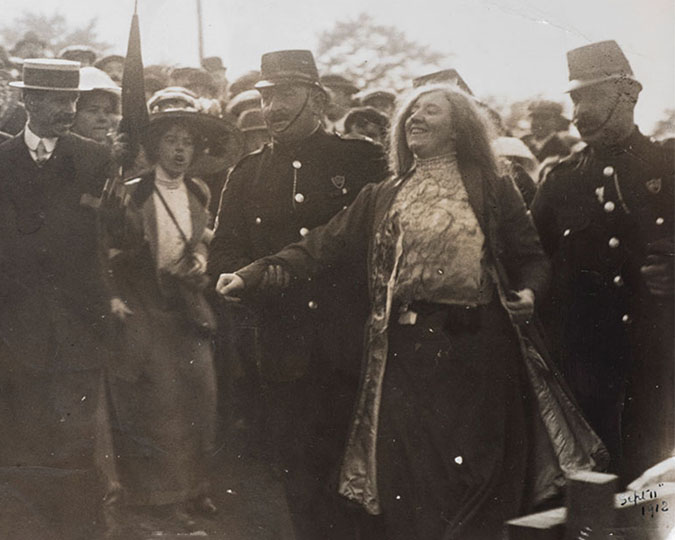
The WSPU headquarters moved to London from Manchester in 1906. This move enabled the Pankhursts to organise meetings and demonstrations close to the heart of the government and Houses of Parliament. These gatherings often resulted in confrontation with the police and the arrest of the suffragettes.

The activities of the WSPU were widely reported in the press and the Pankhursts became well-known throughout the world. In 1906 the Daily Mail first referred to members of the WSPU as 'suffragettes'. This name became widely used by both supporters and opponents of the campaign.

Many suffragettes committed acts of violence to keep the 'Votes for Women' campaign in the public eye. Members of the WSPU were responsible for breaking the windows of 10 Downing Street, burning buildings and damaging paintings in public galleries. They were often prepared to go to prison for their cause or even put their own lives in danger.

On 4 June 1913 the suffragette Emily Wilding Davison threw herself under King George V's horse at the Derby horse race. When she died from her head injuries four days later, the WSPU hailed her as a true hero and organised a large funeral procession.

Prison and hunger strike

Imprisoned suffragettes often went on hunger strike to protest against the conditions in which they were held. The government was determined that no suffragette would starve to death. They believed that a suffragette who died for the campaign would receive much public sympathy, making it difficult for the government to continue to resist their demands.

To prevent the death of the hunger strikers, the government introduced a policy of force-feeding. This involved forcing a feeding tube down the throat or nose of the prisoner and then introducing liquid into the tube. The procedure was very violent and often caused pain and sickness.

The practice of force-feeding was very unpopular with the general public and in 1913 the government passed The Prisoner's Temporary Discharge for Ill-Health Act. This enabled the authorities to release ill or very weak hunger-striking prisoners for a few days then re-arrest them as soon as they were better. The women, however, often went into hiding before they could be recaptured. The suffragettes referred to this as 'The Cat and Mouse Act' because the government was treating the prisoners in the same way as a cat treats a caught mouse - it releases it from its grasp and then, just as it begins to run away, it recaptures it.

First World War

With the outbreak of the war in 1914, the WSPU ended their political activities. All suffragettes were released from prison and the Pankhursts channelled their efforts into supporting the war effort.

Many women worked very hard during the war and took jobs normally undertaken by men. The huge numbers of men needed to fight the war and the high numbers of casualties amongst the soldiers serving in the trenches resulted in women being employed as gas workers, coal heavers, transport workers and ambulance drivers.

When the war ended, the tremendous war effort of these female workers was rewarded by the introduction of a bill that allowed women over 30 years of age with property to vote in parliamentary elections and even become MPs.

The second instalment of women's suffrage finally came in 1928 when all women over the age of 21 were entitled to vote.

Beverley Cook Department of Later London History and Collections, Museum of London August 2002

For more information...

Visit the Museum to see...

The World City galleries include a display relating to the suffragettes. Included in the display are photographs, the Hammersmith banner, hunger strike medals and a film of Emily Wilding Davison throwing herself in front of the King's horse at the Derby.

Find these books in your local library...

Atkinson, Diane. The Suffragettes in Pictures (Sutton Publishing, 1996)
Mackenzie, Midge. Shoulder to Shoulder (Penguin Books, 1975)
Pugh, Martin. The Suffragettes (Allen Lane, 2001)

Visit these websites...

What political rights did Victorian women have?

The emancipation of women

The suffragettes

Emmeline Pankhurst

top
 
Level A conformance icon, W3C-WAI Web Content Accessibility Guidelines 1.0 Curriculum online logo: link opens new window