By the late 19th century, London had two small Chinese communities in the East End. Chinese sailors from Shanghai had settled in Pennyfields in Poplar. In Limehouse Causeway, another group associated with southern China had settled. Virtually all were single men, some of whom married British women.
By 1914, there were around 30 businesses and 300 people living in these small East End communities. Limehouse and Pennyfields became known as ‘China town’, and many of its inhabitants made a living through running laundries. In 1937, the first Chinese school opened in Pennyfields.
During the Second World War, around 10,000 Chinese men enrolled in the Merchant Navy while others defended Hong Kong and undermined Japanese forces in the Far East.
In London, bombs badly damaged the old dockside districts. London’s Chinese community moved west to find a new centre in south Soho, which at the time was a run-down area.
The number of Chinese in London rose five-fold during the 1950s and 60s. Wives and children joined the single men who had migrated after the Second World War in search of work. The 1950s saw Chinese hand laundries made obsolete by automatic washing machines. But the restaurant and catering trades began to boom as dishes such as sweet and sour pork and chop suey became favourites in the British diet.
South Soho suited the Chinese community well. In 1961, the first Chinese community centre opened in Gerrard Street and by 1970, a network of Chinese businesses was flourishing in ‘Tong Yan Kai’, (Gerrard Street, Lisle Street and Little Newport Street).
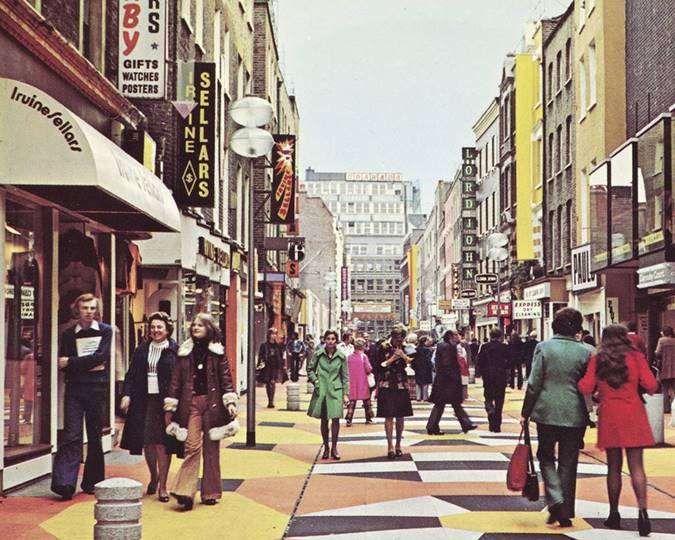
During the 1980s, Westminster Council officially recognised the Chinese character of south Soho by branding it ‘Chinatown’. Gerrard Street was pedestrianised. Chinese street furniture and a pair of grand imperial gates were installed. In 1985, the first organised Chinese New Year celebrations took place.
At the beginning of the 21st century there were around 80,000 Londoners of Chinese descent (a third of the entire Chinese population of the United Kingdom). Until recently, most settlers were Cantonese and came from Hong Kong, particularly the rural villages of the New Territories. Most spoke Cantonese or Hakka.
People from mainland China joined the Cantonese from the 1990s, bringing new dialects and new cuisines. A growing number of London’s Chinese restaurants offer Sichuanese and Hunanese dishes alongside the traditional Anglo-Cantonese staples.
Since the 1960s, the Chinese community in London has built a strong network of social support and welfare organisations. Schools, medical centres, housing associations and Chinese Churches have all flourished. Today there are Chinese community centres in Chinatown, Lambeth, Camden and Haringey and a Chinese Cultural Centre on the South Bank.
Chinese traditional medicine and Chinese martial arts have both ‘crossed over’ into mainstream British culture. Tufnell Park is the home of a branch of Shaolin Temple school of martial arts, one of only two branches outside mainland China.
Private clubs and gambling houses also flourish. One notorious club was the Chi Kung Tong, the first Triad Society in Britain. Anglo-Chinese author Timothy Mo wrote the shortlisted Booker Prize novel ‘Sour Sweet’, about an immigrant Chinese family running a London restaurant who become entangled with a group of Triads.
London’s modern Chinese community is concentrated in three boroughs: Westminster, Barnet and Southwark; but there is talk of establishing a new Chinese business and cultural quarter in East London as part of the ‘Thames Gateway’ regeneration.