


Museum of london

Home / Sir Ralph Felmingham / Court life

feedback | links | wordlist | sitemap | help

Home | Teachers notes

Family life Education Work City life Religion Court life
Photograph of a D shaped metal object the size of a belt buckle. It has a plain flat base plate with a second flat layer above it following the curved outer edge. This top plate is inscribed, decorated and has a moulded decoration at the centre in the shape of a woman

Silver chape, 1509-27

Enlarge image

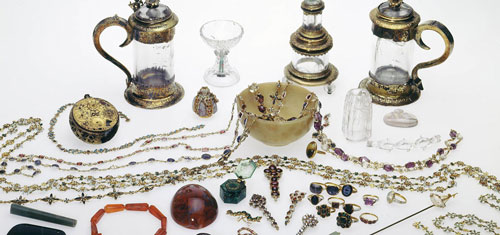
Photograph of a white glass vessel with a round base, narrower top and a looped handle. It has decorative silver bands around the top and bottom, and an elaborately decorated lid silver with a hinge.

Drinking tankard, 1546-7. The silver gilt base was made for a pot which belonged to William Parr. The pot was later broken and replaced with this glass.

Enlarge image

3

Court life: hoping for reward


Tudor kings and queens spent much of their time surrounded by ladies of the court and gentlemen called courtiers. When the monarch moved from one place to another, the court went too.

Where did the kings and queens live?

Henry VIII and his father Henry VII built, or rebuilt, several royal homes in London. These included the Tower of London (begun by William the Conqueror), the Palace of Westminster and Baynard's Castle on the Thames near St Paul's Cathedral.

Both Henry VIII and Elizabeth I were born just outside London in the royal palace at Greenwich. There were also palaces at Richmond and Eltham. When Cardinal Wolsey, who had been Henry VIII's chief advisor, fell from power, Henry took over his palace at Hampton Court. He made it into one of the most magnificent palaces of all.

Why did the courtiers follow the monarch?

Most courtiers were already rich and had their own houses. They hoped that the king or queen would take notice of them or their relatives, and reward them with jobs or titles that would make them even richer. When Catherine Parr became Henry VIII's sixth wife, her uncle, William, became her chamberlain and was given the title of baron.

However, being a courtier was very expensive. You had to spend a great deal of money on fine clothes and buy the monarch expensive presents.

What was life like at court?

Courtiers were given their own rooms in each of the royal palaces. They all had their own servants, who slept either in the same rooms or in the corridors. At Hampton Court, when King Henry VIII was in residence, about 500 people lived there. There were three enormous kitchens where cooks prepared all sorts of roast meats, pies and fancy desserts. Rich people were not very fond of vegetables though! Everyone at court was also provided with a daily allowance of wine (for the courtiers) or beer (for the servants).

Did the court always stay near London?

Sometimes, when there were outbreaks of the plague for instance, the court left London for the country. Elizabeth I was particularly fond of travelling around England and staying in the homes of her courtiers as it saved her money. It cost them a fortune, but was considered a great honour.

Back to personalityGo to object details
Graphic: detail taken from the painting 'London from Southwark', c. 1630, Anglo-Dutch School

Learning | contact us | legal disclaimer | credits